|
“They are not judged for
doing tricks”, Good said. “They
are judged on how closely they meet the standard for that breed.”
Founded
in 1898 by Chauncey Z. Bennett, the UKC has supported the idea of the “total
dog,” meaning a dog that looks and performs equally well. The
performance programs of UKC include Conformation Shows, Obedience
Trials, Agility Trials, Coonhound Field Trials, Water Races, Nite
Hunts and Bench Shows, hunting tests
for the retrieving breeds,
beagle events including Hunts and Bench Shows, and, for Cur and Feist
Squirrel and Coon Events, and Bench Shows.
The
ranking Goodie has received is rather difficult to retain since within
the Sylvania area there are not many competitions. The Perry show is
the closest.
The
No. 2 dog, Good said, is eight points behind in the standings as of the
May 16th posting
on the website.
Approximately
100 dogs attend multi-breed shows at most competitions in our area.
The premiere shows can have several thousand dogs and many more breeds,
Good said.
“They
can pull entries from all over the nation and internationally,” she
said.
Under
United Kennel Club rules, professional handlers are not permitted to
show dogs, only owners can.
“It
is a family-oriented registry,” Good said. “It promotes family
participation and competition
and they promote junior
handling. They take the politics, so to speak, out that you may find in
some other shows.”
Goodie is the first of three Shelties to finish, or complete championships, this
year under the guidance of Good, who has shown dogs “strictly as
a hobby” since 1965. The other two canines are females.
“Each
one is very special,”. Good said. “Maybe this year we will raise a
rare litter for another winner.
“Goodie
is now working on his grand championship,” she said of the canine who
has two of the five necessary points to reach the goal.
|
|
Photo
by Enoch Autry
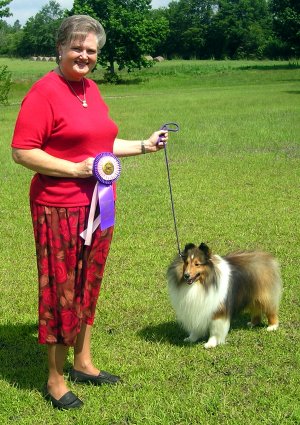
Goodie, a sheltie, stands at attention for his owner Joy
Good.
Within
a show, a winning dog competes against other dogs of the same sex,
against of opposite sex and against other champions to award a best of
breed.
“The
best one goes back in to compete for group. The first place group
winners compete for Best in Show,” Good said. A canine also can
receive a reserve best in show “The day is long.”
Good
started showing collies and raised them for 20 years, but wanted to
make a change.
“I
decided I wanted something smaller,” she said. Good has shown
shelties since 1990.
Since
1948, the United Kennel Club has recognized this breed of shelties,
which has a rich history
Sometime
around 900 A.D., the islands off the coast of Scotland were colonized by
Norse people who brought with them the ancestors of the Shetland
Sheepdog. These ancestors were Spitz-type dogs, probably similar in type
to today’s Iceland Dog and the Swedish Vallhund. Over time, the
Shetland islanders developed a small, highly intelligent dog,
capable of herding with little or no supervision. The island’s harsh
climate required a hardy, small dog with a thick, weather-resistant
coat.
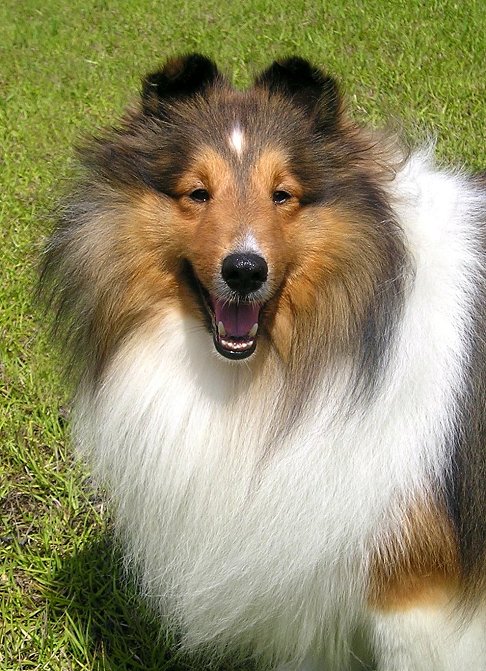
The general appearance of the
Shetland Sheepdog is that of a rough collie in miniature.
|
|
In
the 15th century, Shetland became part of Scotland and began importing
sheep from the mainland. The Scottish Collie, then slightly smaller
than today’s breed, was crossed with the Shetland dogs to give the
island breed a more distinct Collie-like appearance.
Today,
the Shetland Sheep-dog is a popular companion and working dog, excelling
at all events requiring intelligence and agility.
Photo
by Bob Good
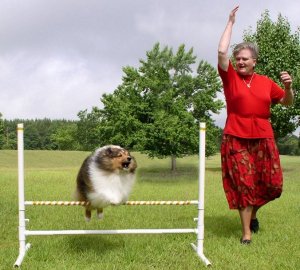
Goodie conducts some agility training
by working on his jumps. Good said agility is the next line of
competition for Goodie after conformation showing, which the sheltie
currently ranks first.
The
height for a mature Shetland Sheepdog ranges between 13 and 16 inches
and the weight is proportional to it's height. A show dog will be
disqualified for heights above 16 inches or under 13 inches. "Goodie
is just under 16 inches, but is a nice big male," Good said. The
Shetland Sheepdog is affectionate, loyal, highly intelligent and an
extremely willing worker. Shelties may be wary with strangers but are intensely
devoted to their family members, including children and other
dogs. Shelties excel in performance events, and many still serve as
working farm dogs. Shelties make excellent guard dogs, alerting to any
intrusion with enthusiastic barking. The
sheepdog has a thick, weather-resistant, double coat. The outer coat is
long, harsh textured and straight. The undercoat is soft, short and
dense. A sheltie is a herding dog that requires an easy, almost floating
movement, agility and endurance. |